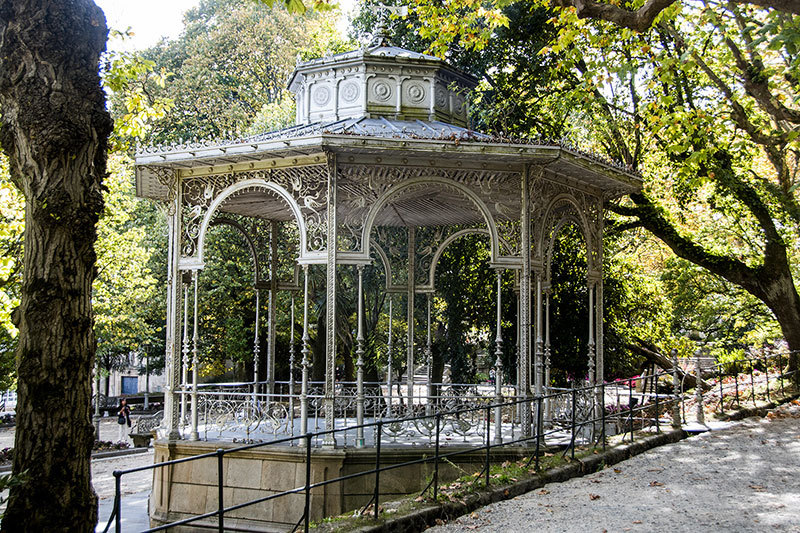
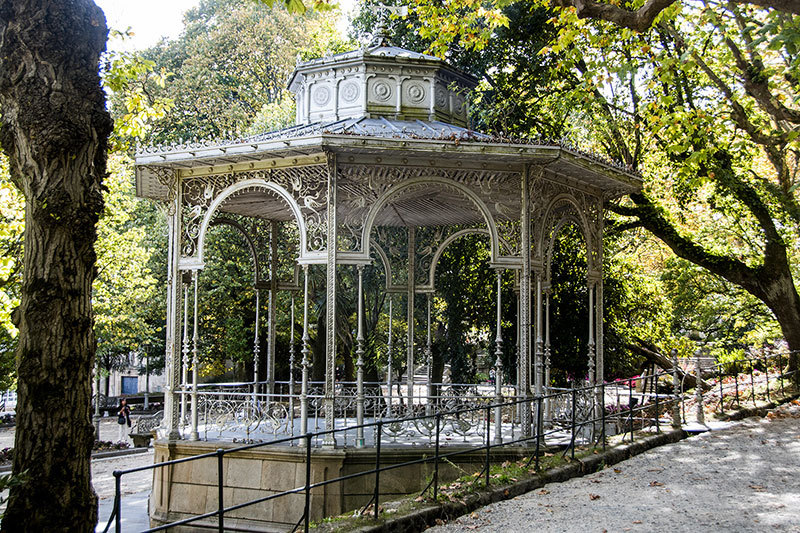
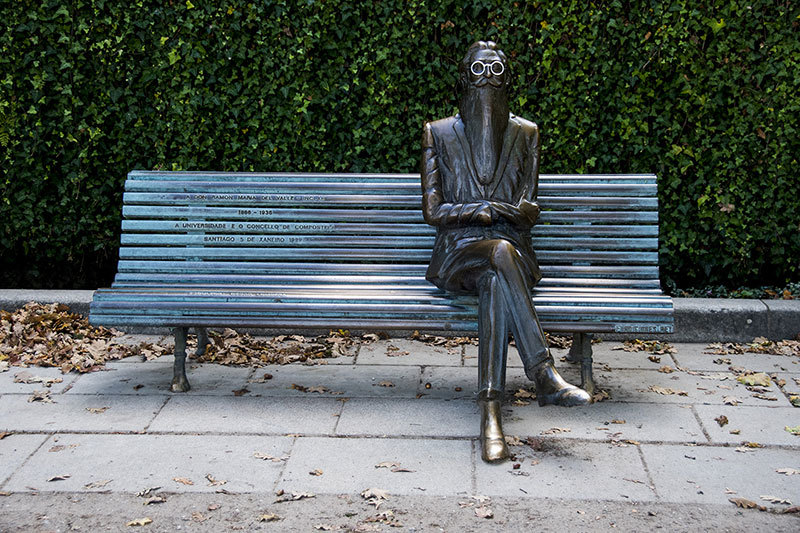
It was built on land donated to the town of Compostela in 1546 by Rodrigo de Moscoso Osorio and Álvarez de Toledo, fourth Count of Altamira. Although the park receives the generic name of the Alameda, since its creation in the 19th century it has consisted of three distinct parts: the Alameda promenade, the carballeira de Santa Susana and the central promenade of the Herradura.
The latter, also called Paseo de los Leones, was defined by Ramón Otero Pedrayo as the noblest park and promenade in Spain. Here we find the pergola, facing the Pedroso mountain, and several 19th century, modernist, and more recent buildings, such as the chapel of Santa Susana, the church of El Pilar, the bandstand, the dovecote and the acoustic bench.
The latter, also called Banco dos Namorados, allows two people placed at either end of the bench to talk to each other without raising their voices. Built in 1914 by the municipal architect Mariano Fernández Rangel, its main purpose was to serve as an auditorium for the performances of the municipal band in the bandstand. However, the 14-metre, 5-metre-deep structure also lent itself to use in the early 20th century as a discreet meeting place for lovers.
The Park also stands out for the variety and size of the tree species that compose it, such as the carballeira (oak trees), the horse chestnut trees or the giant eucalyptus trees.